
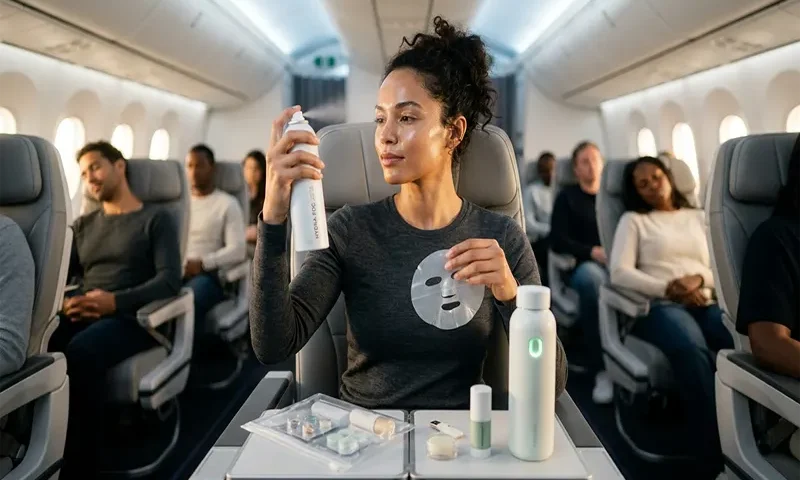
In the high-altitude environment of a 2026 long-haul flight, your skin is under siege. Airplane cabins are notorious for their desert-like conditions, with humidity levels often plummeting below 20%—less than half of what healthy skin requires to maintain its barrier. This environmental stress triggers Trans-Epidermal Water Loss (TEWL), the process where the dry cabin air literally siphons moisture out of your cells, leaving you with the dull, tight, and congested “plane face.”
To step off a 12-hour flight glowing rather than grey, you need a routine rooted in barrier science. Here is your professional, 2026-ready guide to in-flight skincare.
1. The Science of “Skin Shock”
Why does your skin freak out at 35,000 feet? Beyond the lack of humidity, the recycled air and increased UV exposure through windows create a “skin shock” effect. In response to dehydration, your skin may overproduce oil to compensate, leading to the “oily yet tight” sensation that often results in post-flight breakouts.
In 2026, the trend has shifted toward Sustainable Minimalism. Rather than a 10-step routine in a tiny lavatory, we now focus on a few high-performance, multi-tasking products that support the skin’s natural microbiome.
2. Phase 1: The Pre-Flight Preparation
Your defense begins at home. Never board a long-haul flight with a face full of heavy makeup, which can trap bacteria against your skin in the dry air.
- The Double Cleanse: Start with a perfectly clean slate. Use an oil-based cleanser to remove sunscreen and pollutants, followed by a gentle, pH-balanced water-based cleanser.
- The “Hydration Sandwich”: On damp skin, apply a humectant-rich serum (look for Glycerin or Multi-weight Hyaluronic Acid). Immediately seal it with a lipid-rich moisturizer containing Ceramides or Squalane. This “traps” the water before you enter the cabin.
- Sunscreen (The Non-Negotiable): UVA rays are significantly more intense at high altitudes and penetrate plane windows easily. Apply a broad-spectrum SPF 30+ before boarding, especially if you have a window seat.
3. Phase 2: In-Flight Maintenance
Once the cabin door closes, your goal is Preservation.
The “Mist & Lock” Method
Many travelers make the mistake of misting their face and letting it air dry. In a dry cabin, this actually increases dehydration as the mist evaporates and takes your skin’s own moisture with it.
- The Fix: Spray a hydrating mist (avoid alcohol-based toners), then immediately pat a tiny amount of face oil or an occlusive balm over the top. This creates a mechanical seal that stops evaporation.
The 2026 Holy Grail: Hypochlorous Acid (HOCl)
The breakout star of 2026 travel kits is Hypochlorous Acid spray. Naturally produced by our white blood cells, HOCl is a potent antimicrobial that kills “plane bacteria” without irritation.
- Pro-Tip: Mist your face every 3 hours with HOCl to prevent “maskne” and keep your skin sterile without needing a sink.
Targeted Care
- Eyes & Lips: These areas have the thinnest skin and no oil glands. Use a thick Lanolin-based or Petrolatum-based balm on your lips and the outer corners of your eyes.
- The Mask Debate: If you use a sheet mask, do so mid-flight, but you must apply a heavy moisturizer afterward. In 2026, many travelers prefer reusable silicone masks which provide a barrier without the messy drips of traditional sheet masks.
4. Phase 3: Post-Flight Recovery
After landing, your skin is likely in “repair mode.”
- The “Reset” Cleanse: Use a milk or cream cleanser to remove the “plane film”—that mixture of recycled air, old product, and sweat.
- Barrier Repair: This is the time for Niacinamide and Panthenol (Vitamin B5). These ingredients soothe the redness and inflammation caused by the flight’s low oxygen levels.
- The “Slugging” Finale: If your skin feels exceptionally parched, “slug” your face at your hotel. Apply your usual moisturizer, followed by a thin layer of a healing ointment (like CeraVe Healing Ointment or Aquaphor) to lock in maximum hydration while you sleep.
5. The 2026 Carry-On Kit: Navigating the 3-1-1
While many 2026 airports have upgraded to CT scanners that allow for larger liquids, international regulations still largely stick to the 3.4oz (100ml) rule. To save space in your quart-sized bag:
- Switch to Solids: Look for Cleansing Sticks and Solid Serums. These are TSA-exempt as they aren’t liquids, leaving more room for your mists and creams.
- Multipurpose Balms: Carry one high-quality healing balm that works for lips, cuticles, and as an occlusive face sealer.
- Internal Hydration: No topical product can fix systemic dehydration. Aim for 8oz of water per hour. In 2026, many frequent flyers also add electrolyte tabs to their water to help the body (and skin) retain that moisture more effectively.
Summary: Your In-Flight Checklist
| Timeline | Action | Key Ingredient |
| Pre-Boarding | Cleanse + Hydration Sandwich | Hyaluronic Acid + Ceramides |
| Every 3 Hours | HOCl Mist + Lip Balm | Hypochlorous Acid + Lanolin |
| Mid-Flight | Mist & Lock (if feeling tight) | Rosewater + Squalane Oil |
| Post-Landing | Reset Cleanse + Barrier Repair | Niacinamide + Panthenol |
Maintaining your skin on a long-haul flight is a battle against physics. By understanding how to “seal” moisture in and using modern 2026 tools like HOCl sprays and solid formulations, you can ensure your skin arrives as refreshed as you do. Remember: Hydrate early, seal often, and never skip the SPF.

